
Bees & Pollinators›What to plant

What to plant for bees in Southern California.
Twenty four plants that grow here on almost no water, with who they feed, when they bloom, and where to buy them.
Five rules that matter more than the plant list.
Follow these and almost anything you plant will help. Skip them and even the right plants fall flat.
- 1
Natives first.
Local bees evolved with local plants. Natives also drink less, so your water bill helps too.
- 2
Plant in clumps.
Three of one plant beats one of three. Bees find a patch from the air and work it efficiently.
- 3
Bloom all year.
Aim for something flowering in every season. Winter and late fall are where most gardens go empty.
- 4
Simple, open flowers.
Skip double bloom hybrids. Pretty to us, but many have no pollen or nectar left in them at all.
- 5
Ask about sprays.
Nursery plants are often pretreated with neonicotinoids, which Xerces ranks among the most harmful to bees. Ask. Native nurseries usually do not use them. Once planted, handle pests without hurting bees.
Twenty four plants bees actually use.
Nearly all California natives, all easy, all proven in Southern California yards. Filter by when you need bloom, who you want to feed, or whether it lives in a pot.
Showing 6 of 24 plants
-
 Pot friendly
California poppy
Eschscholzia californica
Feeds native bees, sweat bees, bumble bees
Our state flower and the easiest thing on this list.
-

Ceanothus (California lilac)
Ceanothus species
Feeds bumble bees, mason bees, honey bees, butterflies
A blue cloud of flowers in late winter, humming with bees.
-
 Pot friendly
Cleveland sage
Salvia clevelandii
Feeds bumble bees, carpenter bees, hummingbirds, butterflies
Smells like the hills after rain.
-

Black sage
Salvia mellifera
Feeds honey bees, native bees, hummingbirds
The plant behind Southern California sage honey.
-
 Pot friendly
California buckwheat
Eriogonum fasciculatum
Feeds tiny native bees, butterflies, hoverflies, beneficial wasps
If you plant one thing for native bees, plant this.
-
 Pot friendly
Showy penstemon
Penstemon spectabilis
Feeds hummingbirds, bumble bees, carpenter bees
Tall spikes of purple blue tubes built for hummingbird beaks and bumble bee bodies.
-
 Pot friendly
Narrowleaf milkweed
Asclepias fascicularis
Feeds monarch caterpillars, bees, butterflies
The right milkweed for monarchs here.
-
 Pot friendly
Coyote mint
Monardella villosa
Feeds butterflies, skippers, bees
Lavender pom poms and minty leaves.
-

Manzanita
Arctostaphylos species
Feeds bumble bee queens, Anna's hummingbirds, honey bees
Little pink bells in the dead of winter and red bark all year.
-
 Pot friendly
California fuchsia
Epilobium canum
Feeds hummingbirds, bees
Scarlet trumpets in fall when the rest of the garden is toast.
-

California goldenrod
Solidago velutina ssp. californica
Feeds late season native bees, butterflies, hoverflies
Golden plumes for the last bees of the year.
-

Coyote brush
Baccharis pilularis
Feeds dozens of native bee species, hoverflies, wasps, late butterflies
Nobody plants it for looks.
-

Golden currant
Ribes aureum
Feeds hummingbirds, early bees
Yellow flowers that smell like cloves, then edible berries.
-
 Pot friendly
Coast sunflower
Encelia californica
Feeds bees, butterflies, hoverflies
Cheap, fast and covered in yellow daisies for months.
-
 Pot friendly
Lavender
Lavandula species
Feeds honey bees, bumble bees, butterflies
Not native, but the balcony hero.
-
 Pot friendly
Rosemary
Salvia rosmarinus
Feeds honey bees, carpenter bees
Not native either, but it flowers all winter and you can cook with it.
-
 Pot friendly
Sunflower
Helianthus annuus
Feeds bumble bees, long horned bees, sweat bees, goldfinches
Kids love them and so do bees.
-

Toyon
Heteromeles arbutifolia
Feeds native bees, honey bees, butterflies, then birds for the berries
California holly, the plant Hollywood is named for.
-
 Pot friendly
Sticky monkeyflower
Diplacus aurantiacus
Feeds hummingbirds, bees, checkerspot butterfly caterpillars
Orange flowers for months on almost no water, and it tolerates the shady side of the house.
-
 Pot friendly
Arroyo lupine
Lupinus succulentus
Feeds bumble bees, native bees
Purple spires that bumble bees wrestle open.
-
 Pot friendly
Yarrow
Achillea millefolium
Feeds hoverflies, small native bees, butterflies, ladybugs
Flat white landing pads for the little guys.
-
 Pot friendly
California aster
Symphyotrichum chilense
Feeds late bees, butterflies, hoverflies
Lavender daisies through fall when bees are scraping.
-

Bladderpod
Peritoma arborea
Feeds carpenter bees, bumble bees, hummingbirds
Yellow flowers twelve months a year and zero water.
-
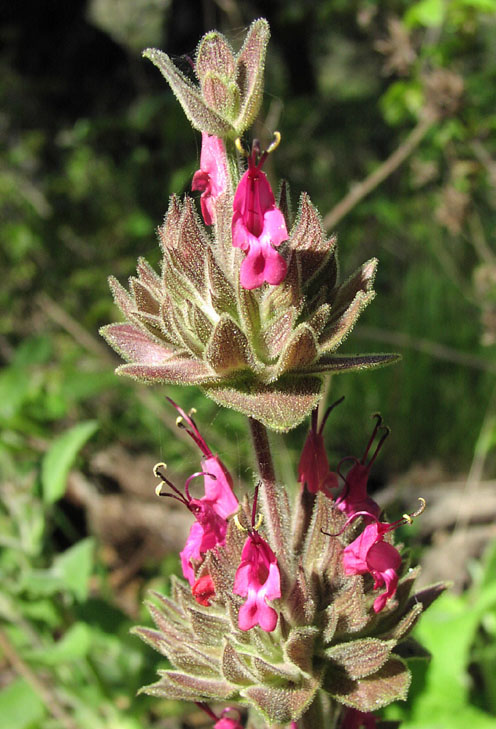 Pot friendly
Hummingbird sage
Salvia spathacea
Feeds hummingbirds, bumble bees
One of the few bee plants that likes shade.
Photo credits
Photos via Wikimedia Commons under their Creative Commons or public domain licenses: California poppy: Diego Delso, CC BY-SA 3.0 · Ceanothus (California lilac): Dcrjsr, CC BY 3.0 · Cleveland sage: via Wikimedia Commons, CC BY-SA 3.0 · Black sage: Bernard Ladenthin, CC BY 4.0 · California buckwheat: Stan Shebs, CC BY-SA 3.0 · Showy penstemon: Stickpen, Public domain · Narrowleaf milkweed: Braines123, CC0 · Coyote mint: Eric in SF, CC BY-SA 3.0 · Manzanita: Jörg Hempel, CC BY-SA 2.0 de · California fuchsia: Stan Shebs, CC BY-SA 3.0 · California goldenrod: Franco Folini from San Franc, CC BY-SA 2.0 · Coyote brush: Cjziems, CC BY 4.0 · Golden currant: Bff, CC BY-SA 3.0 · Coast sunflower: No machine-readable author p, CC BY-SA 2.5 · Lavender: Joanna Boisse, CC BY-SA 4.0 · Rosemary: Kolforn (Kolforn), CC BY-SA 4.0 · Sunflower: Lothar Spurzem, CC BY-SA 2.0 de · Toyon: John Rusk from Berkeley, CA,, CC BY 2.0 · Sticky monkeyflower: Björn S..., CC BY-SA 2.0 · Arroyo lupine: The Marmot, CC BY 2.0 · Yarrow: Humoyun Mehridinov, CC BY-SA 4.0 · California aster: John Rusk from Berkeley, CA,, CC BY 2.0 · Bladderpod: Stan Shebs, CC BY-SA 3.0 · Hummingbird sage: Taken by Antandrus, Public domain.
Three starter plans.
Each one covers all four seasons. Buy the list, plant it in fall, water it through the first summer, and you are done.
-
The balcony trio
Three pots on a sunny railing
Spring, summer and winter covered in three containers. Add a saucer of water with pebbles and you have a complete bee stop.
 Lavender
 Coyote mint
 Rosemary
-
The parkway strip
The dry strip between sidewalk and street
Nothing here needs a sprinkler once it is in. Low, tough, and buzzing most of the year.
 California buckwheat
 Coast sunflower
 Yarrow
-
The ten by ten corner
One corner of the yard, lawn optional
Room for a real habitat: a shrub for structure, spring and summer bloom, and bees from February to October.
 Ceanothus
 Cleveland sage
 Black sage
Find bee plants near you.
Type your ZIP code and we will point you to native plant nurseries and plant stores close to home. Native nurseries beat the big box store every time: better plants, no pesticide pretreatment, and staff who will talk you through your yard.
We will map the nurseries around you and rank the Southern California native plant specialists by distance.
Open this search in Google Maps
You are outside the Southern California nurseries we know personally, so use the map above, or try the Calscape nursery finder for anywhere in California.
Check hours before you drive; several native nurseries open only a few days a week. Your local California Native Plant Society chapter also runs plant sales every fall.
Things people ask before they plant.
Straight answers for a Southern California yard.
What are the best plants for bees?
The ones that grew here before we did. Native plants and native bees evolved together, so natives feed more kinds of bees, more reliably, on less water. Start with the list above, then aim for variety: different flower shapes and colors feed different bees.
How many plants do I need, and how should I arrange them?
More than one, fewer than you think. A good rule of thumb: at least three different plants in bloom in each season, planted in clumps about three feet across rather than one of everything scattered around. Bees find a patch from the air and work it efficiently. Even a few pots on a balcony count if they are in bloom.
Do the plants have to be native?
Native is best, not mandatory. Lavender, rosemary and sunflowers are on our list because bees genuinely use them and they are easy. What matters more is avoiding plants that give bees nothing at all, and never planting anything invasive. If you want one rule of thumb: mostly natives, a few proven friends.
Are fancy hybrids and double flowers okay?
Mostly no. Go easy on varieties bred for showy blooms, and skip double flowered ones altogether: the extra petals often replace the pollen and nectar, so a bee lands and finds an empty plate. Choose the plain species or a cultivar that still looks like a simple, open flower.
How do I know if a nursery plant was treated with neonicotinoids?
Ask. Neonicotinoids are systemic, which means they end up in the pollen and nectar of the plant for months, so a pretreated plant can quietly poison the bees you planted it for. Nurseries that grow their own stock know exactly what they used, and native plant nurseries almost never use them. If a store cannot tell you, buy somewhere that can.
Should I mulch the whole bed?
Leave some of it bare. About seven in ten native bees nest in the ground and cannot dig through a thick layer of bark. Mulch lightly around plants if you like, but keep a sunny, unmulched patch of soil open, and let a few dead stems stand through winter for the bees that nest in hollow stems.
Will more flowers mean more stings?
No. Bees on flowers are foraging and have no hive to defend, so they ignore you. Native bees mostly cannot or will not sting at all. The stings people remember almost always come from yellowjackets, which are wasps, not bees.
When should I plant, and how much water?
In Southern California, plant in fall, from October through December, so the winter rains do the work while roots settle in. Deep soak about once a week through the first summer, then most natives want a deep drink once or twice a month at most, and ceanothus and manzanita want almost none in summer. Overwatering kills more natives than drought.
Native milkweed or tropical milkweed?
Native. Narrowleaf and showy milkweed go dormant in winter, which clears a parasite called OE and cues monarchs to keep migrating. Tropical milkweed, the red and yellow one at every garden center, stays green year round and short circuits both. If you already have it, cut it to the ground each fall, then swap it out.
What should I do with my lawn?
You do not have to rip it out. Shrink it a little each year, mow less often, and stop treating the clover and dandelions as enemies; bees love them. The parkway strip and one corner of the yard are the easiest places to start, and California law says an HOA cannot ban low water plants, only ask that things stay tidy.
Where do I find native plants and seeds?
Native plant nurseries and California Native Plant Society plant sales, not the big box store. Use the ZIP code finder above to map nurseries near you and see the closest native specialists. Calscape lists nurseries by ZIP for the whole state.
Keep going.
- Build a bee hotelThe right tube sizes, where to hang it, and three builds that take fifteen minutes, an hour, or no work at all.Read the guide
- Bees & PollinatorsThe whole picture: why bees matter, what is happening to them, and the four things anyone can do.Back to the guide
- Bee safe pest controlAphids, ants, whiteflies and snails handled with a hose and a bait station, and what to reach for if you must spray.Read the guide
Join the Hive.
Honest wireless on nationwide 5G, no contracts, and 2.5% of our profits working for the bees your new garden is about to feed.
Written by the Ombee Mobile team, a Southern California wireless company that gives 2.5% of its profits to pollinator conservation. Not bee scientists; we check every fact against the sources named here. Bloom times, water needs and pollinator pairings reflect coastal and inland Southern California and come from Calscape (California Native Plant Society), the Xerces Society plant list for the Southern California coast and UC Statewide IPM. Your microclimate will shift things a few weeks either way. Last reviewed September 2026.